
In Dark Road Without Horizon Richard Wood explores the six sites of Aktion T4 and considers how they are memorialised and remembered. From 1939 to 1945, the Aktion T4 programme murdered an estimated 300,000 German citizens; the majority of victims had disabilities, however, the T4 sites also murdered political prisoners and POW’s. ‘A Dark Road Without Horizon’ positions the photographer as a post-factum witness to these murders across six key sites: Hadamar, Schloss Hartheim, Schloss Grafeneck, Brandenburg, Bernburg, and Pirna Sonnenstein.
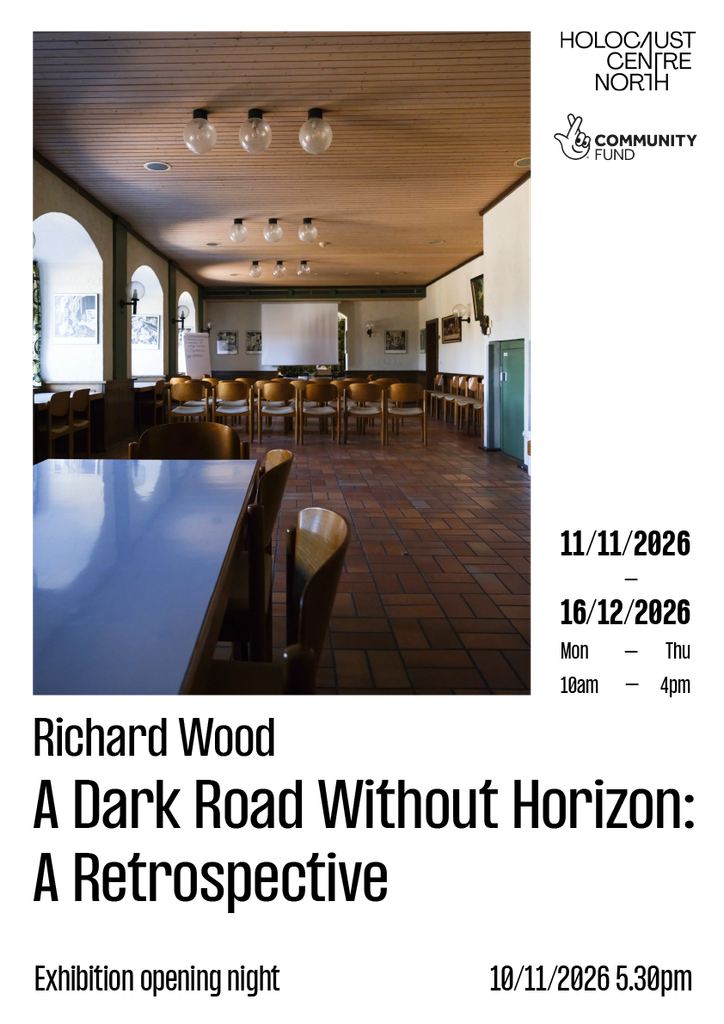
The following interview between Richard Wood discusses his upcoming exhibition at Holocaust Centre North with our Curatorial Officer Elisa. This display which serves as a reflection about his 2024 project A Dark Road Without Horizon, and opens at 17:00 on the 10th November 2026. Book your free ticket for the opening here.
Book a free ticket to the exhibition preview evening on our events page.
This exhibition is drawn from your project A Dark Road Without Horizon, where did this name come from and how does the exhibition meditate on this theme?
The genesis of the project name is a quote from the film Pimpernel Smith. There is a speech at the end. It’s basically a riff on the Scarlet Pimpernel. Leslie Howard portrays a historian and an archaeologist who goes out to Germany, but under the guise of saving people from the Nazis. And it was a propaganda film. But I think his speech at the end of the film is, to me, better than Charlie Chaplin’s at the end of the Great Dictator, which I also love. But it’s on point, prophetic and perfect. It’s a conflation of two sentences. He’s talking about a dark road that they’re heading down, then there’s a central point where he says you’ll find no horizon. This condemnation is directed to the Nazi officer in the scene. So, that’s where A Dark Road Without Horizon came from. This exhibition is like a vignette of that project, I suppose.
This exhibition at Holocaust Centre North is going to be primarily a literal showing of the images and diaries, as opposed to talking about the monuments. The key message of the exhibition is a meditation on post-factum witnessing, and an auto-ethnographic approach to documenting the sites of T4 from someone who knew about the Second World War but did not know about the sites of Aktion T4 until researching them and its connotations in the wider Holocaust.
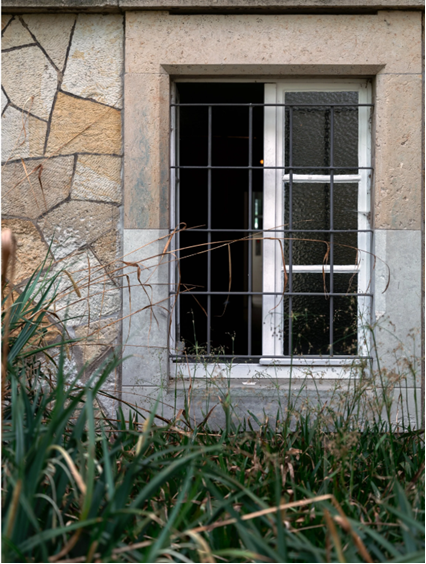
The exhibition text is comprised of the field diaries, around 9000 words, printed up on yellow paper. I am replicating a similar paper style that I saw at the sites, which is what is in the archive. These are arranged in an A4 archive box and are left as an unstapled and unbound collection. I quite like the idea of people messing it up and getting the pages in the wrong place. So, the diaries become this kind of thread of content. All of the photos have that white border because it’s a reference to monoliths, monuments, windows seen and photographed at the sites.
Thinking through your background and practice with documentary photography, how did these experiences translate into your current methodology and approach?
I worked across various aspects of the field. In 2003, I graduated from the Documentary Photography BA at the University of Newport. The course was founded by David Hurn, who was a Magnum photographer. I spent most of my time photographing concerts, and bands doing tours. I spent the next 20 years doing gig photography in between different jobs and in 2001, when the Glee Club opened up in Cardiff, I transitioned into comedian photography. I still do this, and it involves lots of tour posters for the acts that were just up and coming at the time but are on TV now. That was a different experience as well.
I worked across various aspects of the field. In 2003, I graduated from the Documentary Photography BA at the University of Newport. The course was founded by David Hurn, who was a Magnum photographer. I spent most of my time photographing concerts, and bands doing tours. I spent the next 20 years doing gig photography in between different jobs and in 2001, when the Glee Club opened up in Cardiff, I transitioned into comedian photography. I still do this, and it involves lots of tour posters for the acts that were just up and coming at the time but are on TV now. That was a different experience as well.
After feeling creatively at sea, as a long shot, I applied to University of the Arts London (UAL) for the MA programme in Photojournalism & Documentary Photography, which was taking me back to my roots. It was a transformative experience. I got to work with the course leader Aletheia Casey, who is a recent World Press Award winner. She’s amazing, an incredible artist who has now become a friend and colleague. Another defining person that shaped my methodology was Professor Paul Lowe, who was my mentor on the final project. I was going to do a PhD with him, but sadly he passed away a couple of days before that all kicked off. He was a big influence because of his work on post-factum witnessing, along with his incredible work covering the Bosnian war. His book Testimonies of Light is foundational to my practice now moving forward. It put into words what I was thinking and trying to get at, and I didn’t know what it was until I read his writing and it solidified my mindset on this specific field of photography and experience of the photographer. The photographs themselves for me are really important, but they are an end result of all the research and all of the work behind it. That is the actualisation of the body of work.
Our cohort had an exhibition at Free Range in London at the Truman Brewery. I was awarded the Photomonitor Commendation (2024) by Christiane Monarchi who is the Co-Director of HAPAX Magazine. Traction around the project kind of took off from there. Gavin Clark, the course librarian at the UAL LCC, got in touch with me to say their Special Historical Collection wanted to acquire the big archive box I had created. So, when it came to the Freerange exhibition, I had nothing to show and had to get everything reprinted and remade, which is a really cool process, and allowed me to rethink how the images and texts were presented. Nonetheless, it is incredibly humbling having the original work in the UAL archive. They use it to teach some sections of the MA course. About six months after graduating, I was invited back to lecture the year behind me, which was an enormous privilege, but a little nerve-racking, because I knew a lot of them! And from there, I have done some guest lecturing at Cardiff Metropolitan with Michal Iwanowski who made the Go Home Polish book, which is great. All in all, I found the experience at UAL transformative, they are a really good supportive group of people.
So, to answer your original question, going from photographing bands and photographing comedians, which I love, and many of them are my good friends. It is more surface level, as it is an image for the image’s sake. It is an advertisement or it is a review picture. Without all of the depth of the research, I felt I was lacking something. So, I wanted to do something with more complexity. This is where the step back to documentary practice, and ultimately this photo series came from. One day I was looking for avenues of help and assistance for my daughter, who has learning difficulties, and a Google deep dive resulted in me learning about Aktion T4 Euthanasia programme.
Something that I feel an urgency about wanting to focus on with the Holocaust Centre North is experiences of disability. A Dark Road Without Horizon is one way to open a dialogue about these individuals went through during that period. The temptation with histories like the Aktion T4 programme is to compare it to more recent circumstances for people receiving a lack of support from governments and the psychological impact of the narratives that surround this. You have spoken about the Do Not Resuscitate orders that were put onto disabled patients in hospitals during the COVID-19 pandemic.
Not many people know that that happened here, that it even raised an issue of debate that is chilling.
That was the first time that I’d heard of it, through reading your conference paper. So, we definitely do not appreciate the full impact of framing disabled lives as less viable in such cases. You shared some of the Nazi propaganda posters during your conference presentation with us last year where disabled Germans were described as ‘life unworthy of life’. So, it can be a very similar language, which is really uncomfortable. I guess with making work like yours in this context, right now, can it be very tempting to want to compare the two situations in general?
Yes, the parallels of it are quite stark. How could you not compare certain elements? In terms of the Aktion T4, although I knew quite a lot about the Second World War, it was more from the angle of military history, and classic cinema. This was different. I have a daughter who’s got learning difficulties, quite severe learning difficulties. So, the combination of finding out about Aktion T4, which I had never heard about as a kind of… I don’t want to call it this, but it was like finding a blueprint for the Holocaust in terms of the staff and the method and how it was organised. This floored me. Then I realised I had almost… a compulsion to have to go and visit these sites, to bear witness. I did one small project on Hadamar, which was a surreal experience. That was in the first year and the second year, even though I was doing other projects and other ideas, it just kept coming back to me and I couldn’t let it lie. I had to be completist on it and go to all of the six major sites and that’s when ‘A Dark Road Without Horizon’ came into being.
Something you touch upon often in this body of work is the concept of banality, and that is one of the interesting points for me around the visual style of what you’ve produced. A key idea that flashes up is about representing banality of pain when looking at sites that no longer resemble their traumatic history. There are different styles of photography, but a lot of it becomes documentary in order to represent this gap. Some other images frame history through a supposedly neutral lens, but maybe there’s a bit of complication around that. They use realism because of an assumption that they hold up a mirror onto the world. However, the traumatic history spoken about in your images can be invisible in these spaces. We may not be able to recognise the event without the context. You are operating in this gap between the absence where the viewers are in this in-between state.
In terms of liminal spaces like these, I didn’t have a set parameter of image-making. I researched the site and I tried to avoid looking at films about it. Such as when preparing for Hadamar which was the first site a year before. The idea was to respond directly to the spaces, to be on my own, to write and diarize everything, every element of it, the train journeys, the plane journeys, the food, the people. The reactions of the area, the weather, the music I was listening to. And then to respond to the sites directly without being overly informed of the actual site, just armed with the history, the dates, the victims, the perpetrators, but without direct visual references and cues, almost as a true documentary image. And then I realised when I was there that that’s impossible because every element of my knowledge of the spaces imparts itself into the images. Where I stand, the lighting of the day, you know, the reception of the people that I meet when I’m there, every bit of that’s going to have a momentary and visual influence on the work. Even clicking the shutter button two or three seconds earlier or later makes a difference to the image. I did get to the stage at the last site where I physically couldn’t look at what I was taking a picture of because of what it was. In particular, the gas chamber inspection window at Bernberg, the weight of responsibility in that image was consuming, to look through that window was in my mind looking through the eyes of and standing in the footsteps of evil.
That was the last photograph I took for the body of work, two years’ worth of work for my project. As I stood on the train platform waiting to go back to Berlin to get the flight. It just felt totally flat and totally empty, I wanted to shout about what I had witnessed, but life around me just carried on. There was no sense of completion, I felt like I had stepped into a waiting room, with nobody waiting to meet me on the other side.
Each of the T4 sites are independent in some ways. Some are charities, some are run by local governments, and they’re completely disparate. So, how they communicate across them can vary, and every few years some of them go to a conference for example. The local politics of each area can affect my approach to the site documentation. Brandenberg, for example, was the only site that had been completely demolished, which is why I blanked out the images. Everything’s heavily redacted to reflect the erasure.
That sounds like an intense experience. You talked about the experience of spaces of Hadamar, like the grapevines that had been planted. It is indicative of a growing over of nature and, in this case, it was a man-made structure too.
Well, that hospital is quite a big site at the top of the hill. That hill up to the mass grave is only part of those grounds. Whoever that groundskeeper was, or whoever that head of the hospital was, made a conscious decision to plant vines on the banks of the graves. It’s just horrific. Hadamar was quite a still experience because it was February with a muted palette of colours in the landscape, and the town is quite remote. There was a heavy fog over the town in the morning and there was nothing apart from a couple of birds singing when I was taking photographs at the mass grave. I was completely alone there, and it felt like I stepped out of time. I had a Pathé newsreel going through my head all the time, called Murder at the Mill, after the Americans and the British allied troops liberated the hospital. In the newsreel, they are exhuming the mass grave at the top of the site. So, I’m standing where I’ve got this film reel playing in my head and I know what’s happened there. It is a strange experience. I also felt at the time, am I the right person to be doing this? And do I have a right to do this? And why am I here? It is a conflicting experience.
It is interesting how you locate yourself in the spaces. Some people say that the camera speaks for itself and there’s not a human actor in it and that’s how it can be so objective as a medium. But it seems here that there’s a battle between your decisions behind the technical equipment and what comes out the other end and how you position yourself there. Do you want the viewer to see the image through your eyes or is it more that you’re an absent observer?
That’s where I can put my finger on it. It goes back to Paul Lowe’s work, where it’s about bearing witness and providing testimony. From my point of view, the kind of struggle I had with the first site was because I wasn’t really sure how I was going to react or approach or take the images. Then that solidified after thinking about it for a solid year with the other projects and then going back to do the other five sites is when I decided that is the only way I can really approach it. The images are the stark scenes of what I’m seeing, but the whole experience is based in autoethnography and writing and diarizing and giving it my personal context and the context of placing.
My daughter was asking about the project. It was not intentional, but it was impossible to not transpose us into that situation. Reconciling that and realising if we were there, in that time, what could have been the consequences. Truly horrific. When I was talking to Daniel Hildwein, at Schloss Grafeneck. He was incredible, and we spent the day walking the site when the museum was closed. He just took me there and reopened everything. It is a residential home now. There’s a residential home on the grounds of where the gas chamber was for disabled local residents. It is a weird dichotomy, this cognitive dissonance that’s going on there. He was talking about a story of an eight-year-old boy with epilepsy who was a victim of T4, so he has that personal response because he’s got a young family as well. You cannot be in those spaces and then not put yourself in that situation or think “what if”. That was the genesis for realising the project: I must give it my own experience and the mentality of eating bad food or meeting different people, that informed the project. Then, to wrap it up in that archive box and hand it in, was kind of me saying “right, that’s the door closed on that now”. The reality is that the door is never closed, the experience lives with me.
How does this align to the responses that you’ve received from other members of the historical community or photographers? or, perhaps the local community at the sites? Have members of disabled communities reflected on this with you?
So I haven’t spoken to the local disabled community about it really. I’ve spoken to my daughter about it, but because of her issues, she understands but doesn’t fully comprehend the enormity of the Aktion T4 murders. By its nature, it’s not a project that you can easily drop into conversation, it requires time, explanation and consideration, that is why I’m very pleased to have a selection of images and texts find a home at Holocaust Centre North.
A lot of the conversations that we have around what we hold in the archive or when artists are making work are questions of re-traumatizing people by looking back. But then there’s a compulsion, I feel, to have this string of remembrance. Has the project changed how you view remembrance around these events?
This is somewhat where I got the anchor in ‘Berlin Junction’, which is the Richard Serra public sculpture on Tiergartenstraße. It was never intended to be a monument. In Berlin there is the Philharmonic next to Tiergartenstrasse park, the administration offices of Aktion T4 were based at 4 Tiergartenstraße, this is where the naming convention for the action came from. The blue glass wall, which is the Jewish Memorial of Remembrance is around 15 metres away from the Richard Serra sculpture, and in turn the Serra sculpture has become an unofficial, counter memorial. The first trip to Berlin to see the sculpture is when I started to notice the repeated visual language of rusted steel, monoliths, and frames to spaces. None of the sites knew much about each other’s visual presentation of materiality, or memorialisation, but the majority used these monoliths and rusted steel structures. Talking to each contact at the sites about the shared visual language, to find that it was not a conscious decision by each site to memorialise this way was a fascinating revelation. To have a distinct visual language evolve organically and independently across Germany and Austria was a profound revelation. In experiencing each site, it looked to me like a conscious decision, to find otherwise is something I would really like to explore more.
Berlin Junction became a sounding board for me. Every time I went to a site after this, I’d go back and visit it and it became this totem, an echo chamber. I suppose, towards the whole project. In terms of memorial, unless you’ve experienced the sites, been to the places or know the history. This goes back to James E. Young’s Texture of Memory. It just becomes this convenient structure, which is kind of bundled up and now you’re able to not worry about it and walk past it. It is there to forget as opposed to remember. So that’s why I’m trying to create the images and create conversation in the writing because it makes it visceral and real and makes it immediate, especially when you can compare and contrast it to what’s currently being soundboarded in current affairs. Sadly, I think we are standing on the edge of being openly guided into falling into the same historical traps because by and large people lack interest in gaining knowledge of history or an awareness of the wider global community. I think it’s vitally important. If a monument is abstract, it doesn’t immediately mean anything, with meaning only later imbued by knowledge and experience.
For me, when I have done personal projects and documentation, I end up looking back at places that I have visited many times with this new eye trying to find non-existent evidence of things that have happened or reading into everything in a really extreme way. When you look at a grave and you see the inscription, then look again and you read it again differently. For you, this was visits, then a year of research and then going back over the next six months throughout this project. Is there something about the state of mind that you get into in that process? Because I find it really difficult.
I would think about it nearly every single moment of every single day, it became a pervasive background hum to whatever my day-to-day reality was. Even if I was at work, I could be doing anything, just paperwork or whatever and something pops into my head. Today, two years after completing the project, a random interaction, visual cue or conversation will cause a T4 moment to pop into my head and it becomes all-encompassing. I have to find distraction and shake it loose. I think, looking back, it was clearly a traumatising experience. I didn’t realise what I was letting myself in for until I was saturated in the experience of history. There is no support network when you’re doing a project like that, and I wasn’t looking for one because I wanted to experience it on my own. I think that was important. There is probably not a day or a week that goes by where something doesn’t pop into my head.
It’s hard to translate scale in that sense, right? The absence, or if something is abstract, conveys the fact that the victims are no longer present. So that’s an obvious route, but I find that personally really difficult to grapple with. The absence of people. How do you represent someone that can’t tell you about it themselves?
Well, Action T4, which is a facet of early Holocaust studies that not many people know about really. If you look at the earlier research, they were estimating 10,000-15,000 people just at Hadamar. Elements that stuck out to me, and that I was not expecting to discover, was that there was a lot of cash being exchanged in terms of getting rid of people, which is horrendous, and speaks volumes of the complete dismissal and reduction of life. It was also then Spanish Civil War POWs who were getting executed at Hartheim Castle. People go there now to use it as a wedding venue to have their photographs taken, the staff at the site tell people about the history of the castle, but many still use it as a photographic backdrop, so there’s that cognitive dissonance again. I think in total now it’s estimated that approximately 300,000-400,000 people were murdered over the course of T4. That’s the entire population of Cardiff, the capital city of Wales. I don’t even know how you begin to monumentalise that or memorialise it. As somebody involved with it, you realise it is hard to even get your head around the numbers. When you put that into the wider context as well, it’s horrific.
With mass events, which our generation might understand more through COVID where we were constantly seeing numbers and figures around mortalities and hospitalisations, it does not really mean anything out of context. People experience collective amnesia, like we have about the past five years. This is why with stories like the T4 or wider Holocaust, we must humanise people.
It is really odd. I think it could be a mixture of stances – people choose to forget or people are unwilling to learn be it sociopolitical ideologies or facing life with blinkered views, or maybe it is because we experience curated histories and single narratives, where it can in turn become hard to figure out what the truth is, over what is presented by any chosen outlet.
That is, perhaps, why I always come back to photography because the perceived battle with truth and with reality is at the heart of much of the theories about image-making with cameras.
This reminds me of Georges Didi Huberman’s book Images in Spite of All: Four Photographs from Auschwitz. He’s basically talking about four photographs that were taken in Auschwitz, and it’s the only visual record taken by a Sonderkommando of executions. It was a smuggled canister of film that was then developed later, it was thrown outside the wire. There is an ongoing debate that says the images were fabricated, and they’re not. But it’s just the fact that people have that voice to debate things and misbelieve things, it’s just very disheartening, very depressing, and completely diminishes enormous risks taken by the people who managed to capture a glimpsed record of the crimes committed. There was also Lee Miller, who was the fashion photographer, and photographic visionary who for a time worked closely with Man Ray. She photographed elements of liberation at Buchenwald. She sent the photographs to the editor of Vogue with the written plea to say, I implore you to believe this. The fact that people were already questioning or unable to comprehend the scale of atrocity, while it was happening and its direct aftermath is incredible and in parallel completely understandable, to present these realities to what was considered a civilized world and expect them to digest and understand what was happening must have been unfathomable to the general population, so there is that dissonance between then and now.
The Didi-Huberman text we have looked at with the Memorial Gestures cohort this year is about bark. He went to Auschwitz-Birkenau and was taking photographs of the trees, really close up images of the texture of the bark. It was around the idea of these trees having witnessed what had happened.
Wow, I was not aware of that work. When I was at Schloss Grafeneck with Daniel, they had the Jochen Meyder monument, which is brilliant, rusted steel shelves with all of these little clay models of people, one model per victim. They had the side of the museum where it was just a glazed wall and it blocked out all of the light. And the idea was that every time a visitor went there, they took one of these clay models away, allowing the memory of each victim to escape the confines of the site, and to spread the history of T4 as far as each clay figure travelled; eventually as the figures dwindled in numbers at the site, the light would flood back into the building. It was an incredibly powerful piece of work. The shelves are now bare, and visitors have started to replace the figures with stones of remembrance. In the middle of the museum room, they had this huge wooden bowl that was carved from a felled tree on the site but still had all of the growth circles. You can see where the executions were occurring because there’s smoke and dirt in the growth rings of the tree. I was told that when staff reach out to inform families that their relatives died at Aktion T4, some of them are open to it, but others still don’t want to know about it. Apparently, a lot of people don’t want the stigma of disability in their family bloodline. There are so many threads to pull on all of these things. In all of the places, there was an overwhelming weight and sadness to every single brick and step in every one of the sites. It was claustrophobic. Even if you were outside, you felt cocooned by this.
This feeling of a space as claustrophobic is interesting. Could it relate to notions of time? We may feel like we are stuck in a set space of time, and by taking a picture or a video, you jolt time and it creates an opening again. So, you close and then you open and then it kind of closes again within the frame. What’s at stake by doing that?
I’m not particularly superstitious, I don’t believe in ghosts, but I believe now after doing this that the fabric of the building is almost like a recorder. It’s not intended as a flippant remark about a haunted house, but I do think there’s an imbued resonance in the place of the weight of its own history. I would like to see if somebody went to this space and didn’t know what happened there, how they would react to the space. I think that would be interesting, is it our knowledge of an event at a certain pace that provides it with a resonance and solemnity? I walked into one of the rooms at Pirna Sonnenstein which is shown in my image of the steps with the crosses. There was a mark on the wall of some old paint. Up until that point, I had actively avoided going into any of the gas chambers because I just didn’t want to stand inside that space, there was a line that I was unwilling and unable to cross. I walked through the basement space, and I was in this room taking a picture of a paint remnant on a wall. I asked my guide where we were and she said, “oh, you’re standing inside the gas chamber, We’ve taken that wall down for the museum”. She kept talking to me, but I didn’t hear anything. It was just this muffled, mumbled noise. I couldn’t move and I genuinely felt like I was sinking into the floor. It was a truly awful experience to unwittingly cross into a space that I had actively avoided being in. Pirna is the site where they have trees on the hillside directly adjacent to the gas chamber. The bases of the trees are painted black and white, and this marks where the majority of the ashes were dumped. It was only recognised as a mass grave site in 2010. It’s on such a steep hill, there are people’s roofs of houses directly below this hill, the houses were there during the mass cremations.
Visual records from other sites of them in operation are sparse: one photograph of the chimneys with smoke coming out of the Hadamar and that was taken by a farmer who was complaining about hair and ash on his field. In contrast, at Hartheim, some of the local population got on well with the executioners and they all went on day trips on the same buses that were used to bring the victims to the castle. Horst Schumann, who did the experiments at Auschwitz alongside Mengele, was originally based at Schloss Grafeneck where the very first gas chamber was built. He got promoted until they came to the Final Solution. He was picked to set up the architecture of the mass gas chambers. Also people like Irmgard Huber, who was a nurse at Hadamar. After the trials, she only served 12 years in prison. She was a major perpetrator and facilitator at Hadamar, who directly was involved with the gas chambers, lethal injections or starvation. Following her time in prison, she went back to live in the village and died there in the 1980s. Horst Schumann changed his name, went all over Europe and Africa. He died a free man, evading a full trial on the basis of ill health, a virtue he did not extend to his victims.
After the conference last year, and this exhibition reflection, what are other areas that will inform your work going forward?
With the conference paper, I saw the open call on Instagram but I thought I’d share what I had worked on. I thought it was just going to be students and graduates like me, and instead it was Oxbridge professors and world experts. I must admit I felt a little out of my depth at first. It was a challenge to condense the work to a short talk, but I found the process and the realisation that the work was expanding to new areas for me very invigorating. I really enjoyed the conference; it was such a good event with wonderful speakers who were experts in their fields. The talk I presented was more of a reflection, looking back over the body of work and thinking how the monuments talk. I’m working on a PhD idea again to do this, because I had touched on the monuments with Paul Lowe. Since the initial body of work, I’ve had two years to consider it now, so I really want to get started on this next chapter. The ideas that I am working with focus around James E. Young’s Texture of Memory and case studies such as Camp E715. This camp is in Poland; it is adjacent to Auschwitz III. It’s all part of the same site within about 5-mile radius. They were the British Prisoners of War who were the forced labourers for the IG Farben chemical plant. The factory and urban sprawl have expanded since then, and the plant is called S.A Synthos now. They used to make artificial rubber and petrol. POW Charles Coward was known as the Count of Auschwitz. There’s a 1961 Dirk Bogarde film about him, but it doesn’t touch upon his time at the camp, apart from a single spoken line about it at in the last three minutes of the film. I’ve known that film for 20 years, and upon a recent rewatching, it triggered something. The whole place now is either urban or industrial sprawl, and it’s one part of Auschwitz which has been completely raised, and in effect an urban palimpsest. So, the idea is to go back and use the same methodology of allied aerial stereo photography and turn this to a ground level practice in the creation of stereoscopic images. Then, I would make a 3D architectural massing model of the site based on direct aerial images of the site, and use the modern images as situational, interventionist disruptors around this tabletop model. The model, in turn, becoming a counter-memorial. Finding funding is not easy, however. But I hope to embark on this PhD journey soon.
Book your place at the exhibition launch on the 10th of November 2026 by clicking this link or visiting our events page.